Friday, November 30, 2018

Learn to draw and paint


Everybody at some point in their life wanted to learn to draw and paint. Just by watching children, you could see that these skills are one of those that entice them during their early years. However, not all people decide to take this goal seriously, especially when adulthood comes around. Nevertheless, if you do want to develop this innate skill, it is still possible. Here are the basics that you have to know.
Drawing Versus Painting
One important factor that people do not understand is that drawing is different from painting. Thus, if you want to learn how to draw and paint, this means you have to develop two different skills. Drawing is generally defined as depicting a subject by the use of lines. On the other hand, painting is the art of coating surfaces with paint for artistic or utilitarian purposes.
Thus, the medium you’d be using would be the main difference along with the process itself. Nevertheless, these two disciplines are still related and most often combined to make an art work. Most of the time, drawing becomes a prerequisite of painting; although this is not always the case.
Drawing Basics
For you to start having drawing skills, you should constantly practice your hands and eyes. Do this by sketching. Constantly sketching is the best way for you to learn how to draw more artistically and professionally.
Remember that drawing is developed by constant practice of your hands. This is not improved by merely reading or acquiring whatever book based knowledge that is available. Thus, practice your hand to draw. Be very observant with your surroundings. Try to sketch things or people during your idle time. Doing this is really one worthwhile hobby that could pay off in the future.
Copying is your stepping stone in drawing. Get a model and copy it. It is all right to make mistakes. This is exactly what erasers are for any way. Also, do away with the notion that you need to have professional materials for your work to look good. A simple sketch book and basic drawing pencil and eraser would do.
Painting Basics
On the contrary, painting would entail appropriate materials so that your work would end up nicely done. You would need a couple of brushes that come in different sizes. You also need acrylic paint of various colors, but most importantly, you should have the primary colors, a bigger tube of white and black. However, if you do not want to buy a black tube, you could simply create your own. Do this by combining all the primary colors.
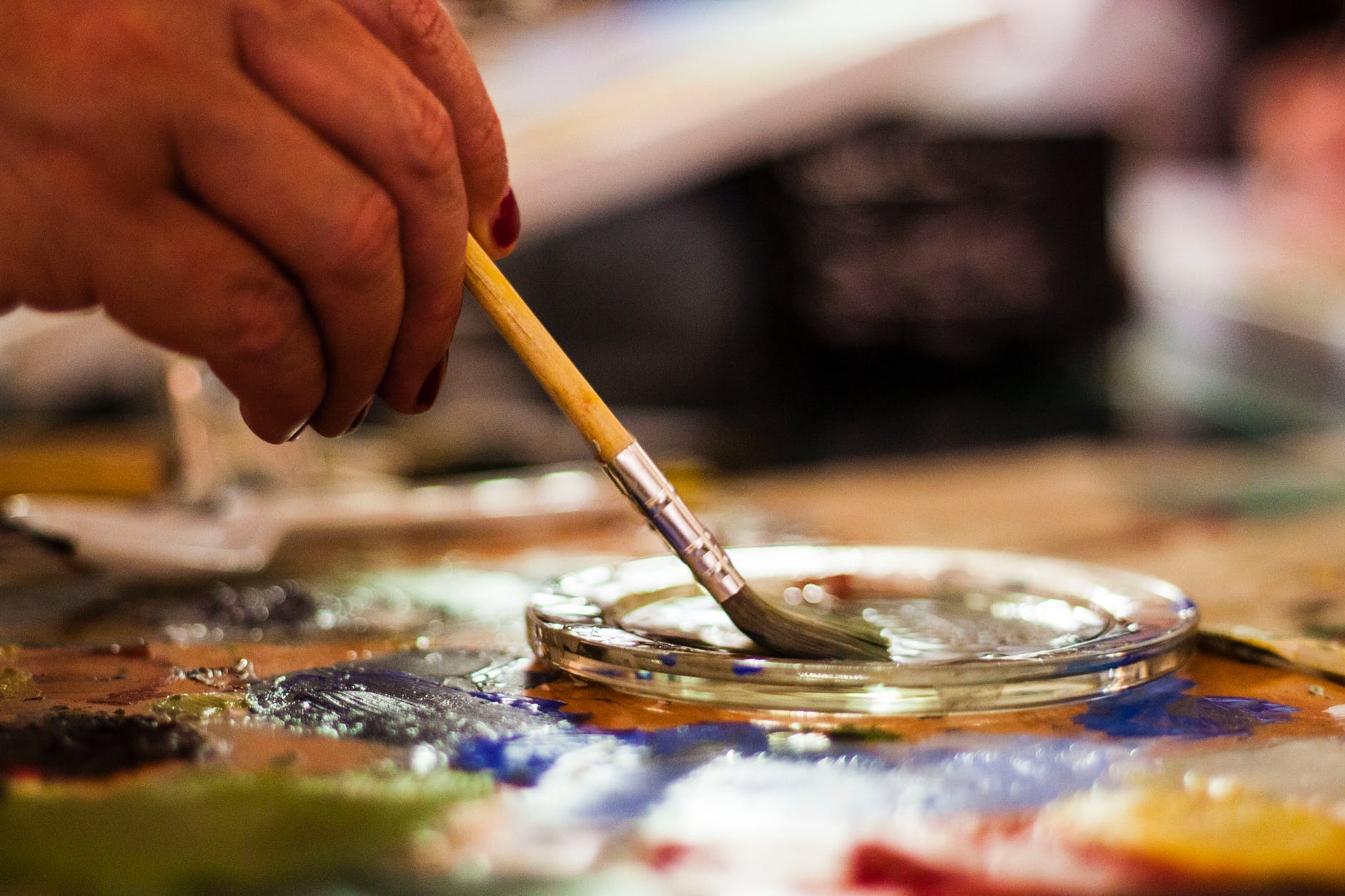
It is best to start with Acrylic paints because these are the easiest to work with. Thus, the general painting developmental stages would be mastering acrylics first before aiming to learn oils or water color. Also, this kind of paint is easily mixed with water. All you’ll need would be a glass or a bucket in which you would put the water in for cleaning purposes. You also use this water to keep your paint moist, it dries up quickly. A pallet is needed too. If you don’t have one, you can improvise by using paper plate that has Aluminum foil covering.
To start painting, you have to draw on your canvas first. Draw your subject and other details of the pictures’ environment. After this, add on the color using your paint. Keep on practicing by choosing different subjects. Also, try to experiment with the colors you’ve got.
[caption id="attachment_100" align="alignnone" width="549"]person holding brown and gray paint brush Photo by Yigithan Bal on Pexels.com[/caption]
Make full use of your pallet and create various shades of colors. Continue on sketching and painting like this and for sure your skill would start to develop in no time.
Blog: of art and craft-hobbies
Website Stores

1
http://art-and-craft-hobbies.com/
2
http://art-and-craft-hobbies.com/shop/
[caption id="attachment_91" align="alignnone" width="548"]ball ball shaped blur color Photo by Pixabay on Pexels.com[/caption]
group Art Studio of Lewis Baber , Post and Sell your ART.

https://www.etsy.com/shop/Magikaljourneys?ref=seller-platform-mcnavArt 
Two Old Guys Folk Art
Share this:
LOOGOSSS
http://Gallery-Wall-Art.com

Buying Paintings: Symbolism

Buying Paintings: Symbolism
Evoking a taste similar to the Romanticist tradition, but utilized mysticism and sensitivity through mythology and dream imagery, preceding the psychoanalytical work of Freud and Jung. With a strong philosophical touch, more so than a style of art, and Art Nouveau and Expressionist artists such as Edvard Munch. Beginning in France as a reaction to the movements of Naturalism and Realism, which seemed to capture the particular components of consensual reality, and presented spirituality and imagination reflecting some artists budding interest in religion and spirituality.
In literature, poet Charles Baudelaire was developing his work and the movement, and especially with such luminaries as Verlaine contributing to the collective effort of the literary movement during the 1860s and through to the 1870s. With the works of Edgar Allen Poe coming to popularity in the 1880s, the Symbolism movement in artwork represented an outgrowth into the darker and more gothic nature of Romanticism, and contrasted with Romanticism’s rebellious and impetuous sides. Symbolist writers wrote in very metaphoric and suggestive manner, to imbue the subjects with a sense of symbolic meaning, and made realistic images into representatives for more esoteric and primordial ideas.
In translating the language of dreams into artwork with symbolic leanings, discovering a visual style that draws upon that philosophical approach that captures a sense of art that has been influential on more than one movement artistically, and has evoked some of the more fantastic imagery to ever cross a canvas. The Symbolist Manifesto was published in 1886, leading to a description of the movement that included ideas such as being hostile towards plain and matter-of-fact meanings, and to express the ideal in a perceptible form was the sole purpose of this art form.
Symbolists that preferred poetic means of conveying their ideas, were known for their techniques of removing technical aspects to achieve a greater fluidity for their work, and became related with seeking use of symbolic images over raw description to evoke the state of the poet’s soul. Paul Verlaine was influential in an 1884 publication defining the essence of Symbolism, through many essays on the relevant poets of the day, and came to the conclusion of relating the works of this movement to the famed philosopher Arthur Schopenhauer, whose own work delved into art as a means of refuge from the strife of the world.
These similarities, which presented a contemplative and artistic refuge using themes such as mortality and otherworldliness, created disparaging arguments between critic and artist alike. Leading to many Symbolist poets of the day to make their own publications and periodicals, and the literary Symbolism then reached its’ peak in the year 1886, with one particular periodical lasting until 1965. Though the two aspects of the movement were distinct, they would occasionally overlap each other, and became a continuation for mystical tendencies in a Romantic tradition, even flirting with the self-consciously dark Decadence movement.
There were several dissimilar groups of painters and visual artists within the Symbolism movement, and the artistic movement seemed to have a greater impact worldwide than the literary movement, reaching multiple artists and sculptors from such distinct parts as Russia. Many of the symbols found herein are not necessarily universal, but more personally affected with the artist’s obscure and private references, with some dreamlike subject matter influencing later Surrealists. Symbolism has had a strong link to music for a while, and mostly due to the enthusiasm for the work of Richard Wagner, whose own music reflected his influence from the philosopher Schopenhauer.
Symbolism even grew to affect some of the literary fiction contributed by Oscar Wilde and Paul Adam, and has a pronounced ring when speaking about movements that have literarily and artistically that have crossed over into other inner groupings of artistic work. The waters of Symbolism have even filtered down the centuries into the state of motion pictures today, and early on held influence with Russian playwright Anton Chekhov, as well as Russian actor and director Vsevolov Meyerhold’s method of acting that influenced early motion pictures.
It is difficult to overlook Symbolism’s influence and repercussions throughout the timeline to the current period of the world, as it drifts through many aspects taken for granted on a daily basis, and many pieces of work for many artists from writer T. S. Eliot to painter Pablo Picasso and even the state of horror films as well. A decidedly different state of the world now has interpreted and reinterpreted all this throughout these hundreds of years, and created more and more material reflections of the state of things as they happen to be.
Website Stores
1
2
Two Old Guys Folk Art
Share this:      
LOOGOSSS

Wednesday, November 28, 2018

Musical Themed Paintings


Musical Themed Paintings
Musical themed paintings can be fun to find and fun to buy. I have a musician friend that recently purchased a new home. She bought new furnishings and asked me to find a new painting for her. I found her a fabulous creation by Osnat. It was an enormous, gallery size painting.
My friend’s new furnishings were very contemporary and the Osnat musical themed painting I bought for her was breathtaking when all five parts were mounted. The musical staff ran the length of the painting with musical notes painted on it. The painting had pretty shades of yellows and oranges. It looked so elegant.
I found a still life musical themed painting of a guitar to buy for a friend. He always has had beautiful pieces of art in his home and he wanted to change some of the pieces he had grown tired of. The abstract piece that I found really struck a cord with my friend and he ended up buying another painting from the same artist.
I found a painting that was called Music of Fire that didn’t really seem to have a musical theme. I showed it to a friend and she told me that the flames looked like they were dancing. She told me that I was using a very narrow definition of musical themed paintings when I was buying art.
Abstract guitars really seem to be my favorite musical themed paintings. I like to buy them when they jump out at me. There is an artist named Slazo that is very prolific with his musical themed guitar paintings. He has had a lot of exhibitions in Florida.
A friend of mine asked me to find artwork by an Armenian named Aram Koupetzian. I was able to find a musical themed painting called Rondo by this artist. It was really intriguing. I’ve never purchased a painting in the Cubist style before. The exact style of this musical themed painting was Synthetic Cubism. I liked it a lot. There is a lot to look at in the painting.
A couple of years ago, a good friend of mine graduated from the University of Texas in Austin with a degree. He had a double major of music and education. He got a job as an assistant band director at a middle school in Austin. As a combination graduation and new job present, I bought him a musical themed painting.
The musical themed painting that I chose was painting by Tilo Rothacker that depicted a jazz musician playing a trumpet. It was so very colorful and it felt a lot like New Orleans. My friend and I had visited the French Quarter several times together. This musical themed painting celebrated his life changes and our friendship perfectly.
My younger sister is quite the accomplished violinist. She moved to New York and went to Juilliard. Her path changed after a couple of years in New York. She stopped pursuing the violin as a career, but her love for her music never waned. I bought her a musical themed painting when she bought her apartment. It was a contemporary abstract with brilliant rich jewel tones that depicted a woman violinist.
I was looking for musical themed paintings one day when I found Melody of Sunset for sale. I’m not sure why this painting bothered me so much. The woman was playing the piano, but she seems disembodied and strange. Her eyes were closed. This musical themed painting just did not strike a cord with me and I did not buy it.

My favorite musical themed painting in a long time was The Sound of Jazz. It was painted by Sarah Kinan and it is gorgeous. It is hard for me to not smile when I’m looking into this painting. The background looks like confetti and the foreground is filled with musical instruments. This musical themed painting can be described as feeling like a party.
Website Stores
http://art-and-craft-hobbies.com/

http://art-and-craft-hobbies.com/shop/
group Art Studio of Lewis Baber , Post and Sell your ART.
https://www.etsy.com/shop/Magikaljourneys?ref=seller-platform-mcnavArt
Two Old Guys Folk Art
Share this:

http://wall-art-gallery.com

Buying Paintings: Romanticism


Buying Paintings: Romanticism
Though sometimes referred to as the “anti-classical” movement in art, Romanticism is a style that focuses on the artist’s individualistic and emotionally wrought point of view, and is found to oppose the art movement known as Neoclassicism. Even though there have been many artists to combine elements of both. Some of the more renowned names around this movement, which utilized strong emotion to convey meaning, were Francisco de Goya and William Blake respectively. This particular art form became a reaction to the outgrowth of reason by homing in on imagination and feeling.
It is not difficult to see the value in the paintings by these artists, and there have been many examples of how other artists have influenced one another over time. As the whole category of Romanticism refers more to the trends of artists, poets, and philosophers of the late 18th and early 19th centuries than as much to an artistic movement. Though one has definitely influenced the other and vice versa rather equally as time went along, there are very few areas in modern life that can be said to stay untouched by the Romantic period, and many agree that this was a vital point in the world’s development as a whole.
Where the people of the period at the time were involved in an overwhelming interest in things of a rational or enlightened nature, the Romantic ideal favored intuition instead, and has been the subject of many differing characterizations of the movement for intellectual and literary histories. There are many varying attitudes on how Romanticism has affected the modern world, and what place this movement has had in the greater picture of history. Some cite Romanticism as being the originating moment of modernity, while others seem to think that it is a beginning to a resistance to the enlightened age, and still others date the movement as a direct aftermath of the French Revolution that is completely continuous with the present.
Romanticism was previously mentioned as affecting music and literature as well as art, but this is less understated than it might seem at first, Romanticism is very prominent in the music and literature of this period. As the age moved along, more than a few critics have considered composers such as Mozart, Hadyn, and Beethoven as being the three Romantic composers. In literature all over the world, the Romanticism movement deeply affected every writer from Johann Wolfgang von Goethe through to even the 20th century’s Ayn Rand, and many more writers between those times when Romanticism was most prominent.
As it became apparent that Romanticism was going to stay a strong influence for many years to come, many critics have taken to confirming that the Romantic period has been elemental in the progress of art to the present day, and that there is almost no famed artist who has not been in part affected by these potent periods of artwork and creative purpose. This rebellion against social and political standards of the age was instrumental in the changing over from those same standards, and created a lush place from which to draw inspiration for the next centuries to come.
Romanticism has become a piece of history that cannot be overlooked for very long as every place that one can turn has somehow been affected by the progress from this one particular time period, though that is certain for many artistic movements that have been present throughout time, and seems to put more clout into the common statement of art imitating life and life imitating art. Neo-Romanticism worked itself out through artists’ reevaluation of the earlier works by those like William Blake, and especially in areas like Britain, creating a new underground of writers, artists, and composers.
Neo-Romanticists have been considered the contrast to naturalism as Romanticism was considered the opposite to Neoclassicism in its’ heyday because of the movement seems to stress feeling and internal observation, as opposed to the naturalistic tendency to stress external observation, and utilize historic rural landscapes to react to the modern world of machines and its’ urbanization. Post-romanticism is an outgrowth of passionate art that refers to a postmodern re-enactment of romantic themes and motifs in contemporary art up to today, and combines the best of traditional artwork with a more modern flair.

In regards to the 20th century turns that Romanticism has made, Romantic realism has evolved out of Romanticism to incorporate elements of themes of value while referring to objective reality and the importance of technique, and was popularized though not coined by the writer and philosopher Ayn Rand. This lead to artists incorporating Romanticism and Realism, though they seemed more weighed to the Romanticist side of the equation, and is considered more as a branching of the Romanticism movement today.
Website Stores

http://art-and-craft-hobbies.com/

http://art-and-craft-hobbies.com/shop/
group Art Studio of Lewis Baber, Post and Sell your ART.
https://www.etsy.com/shop/Magikaljourneys?ref=seller-platform-mcnavArt
Two Old Guys Folk Art

Share this:
http://wall-art-gallery.com

Thursday, October 18, 2018

The Rocks And Minerals Hobby


The Rocks And Minerals Hobby Industry
There are few hobbies that can be shared by the whole family. The hobby of collecting rocks and minerals is one that can interest the entire family. Rocks and minerals are not only educational, but also entertaining and fascinating. One of these hobbyists said in an interview that when she found a new type of rock on her way to New Jersey, she was so overwhelmed with joy, she felt as if she had found Solomon’s gold mine.
Unlike other hobbies, the hobby of collecting rocks and minerals requires that hobbyist to have at least a basic working knowledge of rocks and minerals. Rocks are usually made up of one or more minerals. When different elements combine, the mineral is the result. Minerals are generally without any definite shape. But, when some of the mineral deposits mold into each other, it forms a layer with different irregular shapes and sizes. Some of the minerals also form crystals.
Rocks are easy to collect and classify. Many hobbyists store rocks and minerals in museum like setups. To know and classify a rock requires much geological knowledge and experiences. Many rock collectors often sell their rocks and mineral samples. There are many tools available to break rocks and store them. For sample collection, a hobbyist should have some formal or informal training in handling the different tools for rock sampling, so as not to damage the rock.
Many types of classification exist for grouping the different rocks and minerals. Some of the classifications are:
Classification by color: Store or group all of the same colored rocks and minerals together.
Classification by number of elements: Rocks and minerals that have a certain number of particular elements are stored or grouped together.
Classification by chemical analysis: This type of classification is done only by geologists; they group rocks and minerals according to their chemical composition.
Classification by crystalline shape: this type of classification is for experienced hobbyists, since knowledge of crystalline shape and cleavage pattern is very important.
It is possible to find rocks anywhere you go. If you want to get started with a rock collecting hobby, you can simply go out into your backyard and dig around a bit. Most rock collectors learn to keep their eyes peeled wherever they go, so that no matter what they are doing they will have the opportunity to find new and unique rocks that they wouldn’t have been able to find in their area. It is rare to meet a rock collector who will drive to great lengths to find a rock, but if you are on a family trip or a business trip, you might as well pick up a few local rocks.
[caption id="attachment_media-401" align="alignnone" width="1880"]woman holding six polished stones Photo by Sharon McCutcheon on Pexels.com[/caption]


The hobby of collecting rocks and minerals is never ending. It is a lifetime hobby that increases your knowledge with every new rock or mineral found. To get started, all you need is an identification book and a rock. You can find out all of the information you need, and officially begin your collection with that rock. As your collection grows, you will realize that the hobby only becomes more rewarding over time. So look at the library or the book store today, and find out about the different types of rocks, as well as the tools that can make your life easier.
 Blog: of art and craft-hobbies
Website Stores'


http://art-and-craft-hobbies.com/
http://art-and-craft-hobbies.com/shop/
https://www.etsy.com/shop/Magikaljourneys?ref=seller-platform-mcnav

Abstract Art And The Spirit 1

Title:
Abstract Art And The Spirit 1

Summary:
It has been a long and raging arguement that the abstract expressionists of the 50’s, 60’s and 70’s were very busy contemplating their own navels and trying to find the “zen” in everything they did.
I would argue that they were in fact just one very important example of the hungry sleep-drugged soul seeking a way to be heard. However, many artsists of those times, and indeed today, would flatly deny anything remotely to do with spiritual things – or worse still – religiou…
Keywords:
abstract,art,spirit,soul,painting
Article Body:
It has been a long and raging arguement that the abstract expressionists of the 50’s, 60’s and 70’s were very busy contemplating their own navels and trying to find the “zen” in everything they did.
I would argue that they were in fact just one very important example of the hungry sleep-drugged soul seeking a way to be heard. However, many artsists of those times, and indeed today, would flatly deny anything remotely to do with spiritual things – or worse still – religious things.
Take, for instance, one of my favourites – Mark Rothko. This tragic artist committed himself to the task of producing massive canvases with many vaguely resembling the outline of a window – especially an after image once the eye has closed. His vast expanses of colour seemed to hunt out a corner or edge in a desperate attempt to complete, or conclude, the picture. Not satisfied with that he went on to give up titling his work saying that he did not want to influence the onlooker in any way. Ironically he failed … and sadly took his own life. For me his works speak of wonderful tantilizing clues visually demonstrating the struggling spirit seeking (and succeeding!) in revealing herself – now that is real influence! Let me explain by an apparently unrelated route:
I seek to assist my own spirit in attempting to make manifest even the tiniest, most pathetic, weakest fact that the spirit in us all is not only just trying to communicate with us – but is in fact actively seeking to set the whole human balance right … which is the spirit leading the mind and body back to her source – not the other way round – the mind and body leading the blinded soul to … well, eventually death.
Not so long ago I came across the writings of Meister Eckhart, a fourteenth century Christian mystic. His words amazed me. He described in his many sermons what he believed to be the truth as to why we are here. He also revealed many tantilizing “images” of the spirit from the least angelic being right up to God Himself. His descriptions were … how can I put it simply? … abstract!
In one of his sermons he described God as … “unknowable” … “not able to be understood” … “undefinable”. In another he made a statement (one of many which may have contributed to him being accused of heresy!) “People say God exists … God does not exist … ” left out of context that would be a truly blasphemous assertion. But he went on to say that “… God is far greater … God is beyond existance”. These and many other controversial sayings have impressed me so much that I have come to “see” God as an abstract entity – not, I hasten to add, an anarchic abstract form – but rather a God far more powerful, far more greater – than I can imagine … in other words totally undefinable. Rather than this putting a distance between me and God, it has done exactly the opposite. And when Eckhart began to describe the life of Christ in an almost completely abstract way – Eckhart said that Christs life was the greatest example of the seeking and finding the uncreated source of the pure soul – my imagination began to run like a film of frenzied obscure visuals. Eckhart has become, to me, the patron saint of abstract artists.
The beauty of Eckharts enigmatic words are intensely inspiring. What better way to illustrate his poetic writings than to describe Gods “isness” in the very basic form of a gigantic flat area of one saturated colour untainted by anythingelse. Strangely enough this could be part of an exact description from one of Rothko’s immense, sometimes almost monochromatic, paintings.
But this is by no means the whole story … one of Eckhart’s contradictions said that on the one hand God is totally unapproachable, yet at the same time God is actually very, very approachable …
 Blog: of art and craft-hobbies
Website Stores

https://www.etsy.com/shop/Magikaljourneys?ref=seller-platform-mcnav